Previously (Plasticity – Here, There, and Everywhere)
Expanding the Horizons of Plasticity Collaborations
What is this project about?
Plasticity as a concept is used across multiple academic fields, ranging from neurobiology, through history, to continental philosophy. Can this concept, which resonates with resilience, identity, and time, contribute to other scholarly fields that currently do not use it? Should the academic community strive to expand its usage?
Team
Onur Basak Department of Translational Neuroscience, UMCU; O.Basak(at)umcutrecht.nl
Loai Abdelmoshen, Departments of Chemical Engineering and Chemistry, and Biomedical Engineering, TU/e; l.k.e.a.abdelmohsen(at)tue.nl
Jenny Evang, Department of Media and Culture Studies, UU; j.a.m.evang(at)uu.nl
Mark Sterken, Laboratory of Nematology, WUR; Mark.sterken(at)wur.nl
Ohad Ben Shimon, Department of Philosophy and Religious Studies, Utrecht University / Hague University of Applied Science; o.benshimon(at)uu.nl
Yaron Caspi (External), Department of Psychology, National Taiwan University; ycaspi(at)ntu.edu.tw
Previous Group Members
Jeff Diamanti (External), Faculty of Humanities, University of Amsterdam
Tamalone van den Eijnden (External), Section of Knowledge, Transformation & Society (KiTeS), University of Twente
Esmee Geerken (External) – Previous Group Manager. See Studio Esmee Geerken
Get in touch
O.Basak(at)umcutrecht.nl
Activities
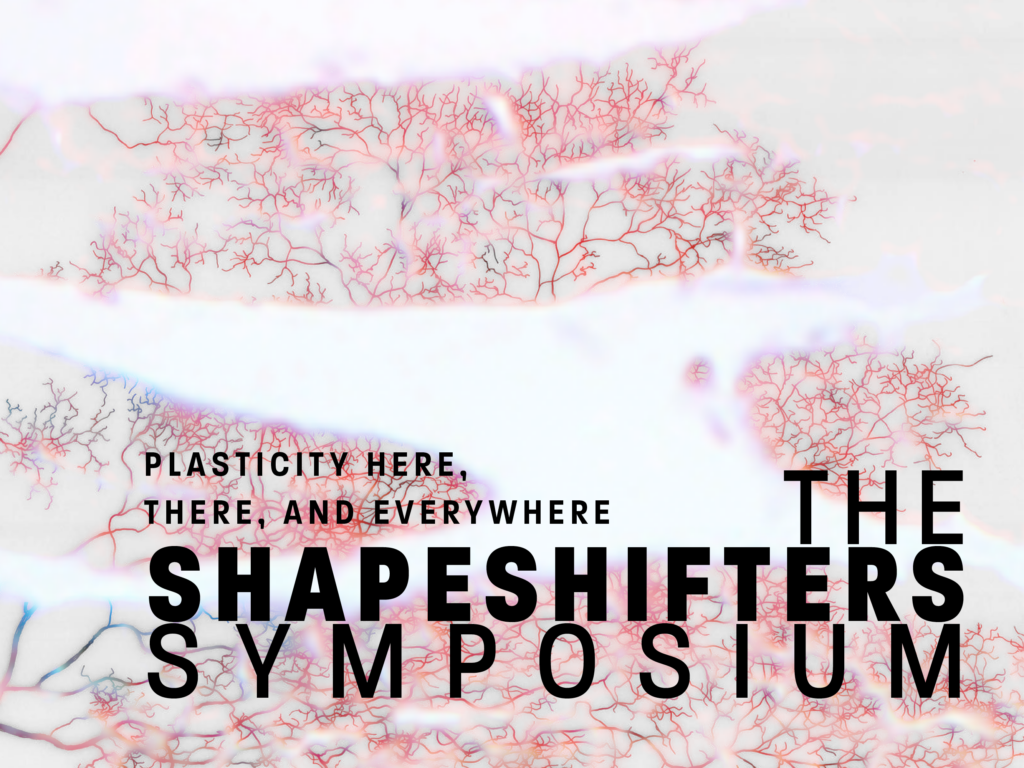
The First International Shapeshifter Seminar, May 2024
In May 2024, we organized the first International Plasticity Symposium. We invited speakers from three continents and many European countries to discuss plasticity with us. Lectures spanned topics such as: Complexity, Circular Causality, Plasticity in Neuroscience, Biology, Education, Art, and Philosophy. The seminar’s output is a series of interdisciplinary articles on plasticity in Interdisciplinary Science Reviews (see below). If you are interested in the lectures, you can view them at the link below (press the link on the image) or on The Plasticity Group YouTube Channel.
Interdisciplinary Science Reviews – The Plasticity Special Issue
In December 2025 and January 2026, after a long and tedious journey, our special issue about plasticity was finally published in Interdisciplinary Science Reviews. If you are interested, please read our editorial of the special issue:
- Forthcoming (link will be shortly added): Loai K. E. A. Abdelmohsen, Onur Basak, Yaron Caspi, Jeff Diamanti, Tamalone van den Eijnden, Esmee Geerken, Plasticity as a Kaleidoscope in Theory and Practice
You can also read all the articles of the Plasticity special Issue
- Forthcoming (link will be shortly added): Joost de Jong, Maria Nogal Macho, Frank Seebacher, Carlos P. Fitzsimons, A minimal model of plasticity across disciplines
- Ohad Ben Shimon, Mercedes Azpilicueta, Negative Plasticity
- Forthcoming (link will be shortly added): Kjetil Horn Hogstad, “All of that richness”. A Plastic Figuration of Interdisciplinarity and Improvisation
- On-Yu Dung, Onur Başak, Tamalone van den Eijnden, Kristina Thompson, Developing an Interdisciplinary Vocabulary of Complexity and Plasticity Using a Case-Study of Plant-Based Diet Adoption
- Amanda Boetzkes, Capitalist prizefighters striking the plasticity of art
- Beatriz Nunes, Plastic Scenes: Images from the future
Plasticity – White Papers
We have written two white papers on plasticity, where we expound on the concept from different angles, and we are currently trying to get them published (which turned out to be a not-so-simple task since they are multiple-disciplinary).
In the first manuscript, we analyze plasticity as a family-wise concept (following Richard Boyd) and discuss its diffusivity pattern. We connect the concept to four theoretical approaches that provide models for conceptual diffusivity in academic and accompanying fields (Boundary Objects and a Threshold, Bridging, and Traveling Concepts). We also suggest five core concepts associated with plasticity (identity and change, stress and milieu/environment, time, complexity, and meaning-making). To show the relationships between plasticity, these core concepts, and the conceptual diffusivity patterns, we analyze in detail three fields where plasticity is commonly used (philosophy, neuroscience, and biology). We close that manuscript by connecting plasticity to the philosophical concept of pluralism (conceptual, dissemination-like, etc.)
In the second manuscript, we show how plasticity can further diffuse and extend its epistemological and semiotic networks. We achieve this goal through a brief overview of the theoretical roots of the concept and an in-depth examination of three fields that can benefit from integrating plasticity into their conceptual frameworks. These fields are complex chemistry, earth sciences, and extra-academic approaches to biodiversity loss. Finally, we relate these possible extensions of the plasticity semiotic network to a broader overview of interdisciplinarity through the idea of semiotic pluralism.
By doing so, we connect the first manuscript to the second.
If you are interested in reading the preprints of these white papers, you are invited to check:
We have written two white papers on plasticity, where we expound on the concept from different angles, and we are currently trying to get them published (which turned out to be a not-so-simple task since they are multiple-disciplinary).
In the first manuscript, we analyze plasticity as a family-wise concept (following Richard Boyd) and discuss its diffusivity pattern. We connect the concept to four theoretical approaches that provide models for conceptual diffusivity in academic and accompanying fields (Boundary Objects and a Threshold, Bridging, and Traveling Concepts). We also suggest five core concepts associated with plasticity (identity and change, stress and milieu/environment, time, complexity, and meaning-making). To show the relationships between plasticity, these core concepts, and the conceptual diffusivity patterns, we analyze in detail three fields where plasticity is commonly used (philosophy, neuroscience, and biology). We close that manuscript by connecting plasticity to the philosophical concept of pluralism (conceptual, dissemination-like, etc.)
In the second manuscript, we show how plasticity can further diffuse and extend its epistemological and semiotic networks. We achieve this goal through a brief overview of the theoretical roots of the concept and an in-depth examination of three fields that can benefit from integrating plasticity into their conceptual frameworks. These fields are complex chemistry, earth sciences, and extra-academic approaches to biodiversity loss. Finally, we relate these possible extensions of the plasticity semiotic network to a broader overview of interdisciplinarity through the idea of semiotic pluralism.
By doing so, we connect the first manuscript to the second.
If you are interested in reading the preprints of these white papers, you are invited to check:
- Yaron Caspi, Onur Basak, Jeff Diamanti, Loai K. E. A. Abdelmohsen, Tamalone van den Eijnden, Esmee Geerken, What Should We Do with Plasticity — A White Paper — Part I
- Loai K. E. A. Abdelmohsen1, Tamalone van den Eijnden, Esmee Geerken, Onur Basak, Yaron Caspi, Jeff Diamanti, Expanding The Plasticity Conceptual Framework to New Dimensions — A White Paper — Part II
Forthcoming: Plasticity – A Cross-Disciplinary Conversation
Currently, we are working on a Book (to be published with Routledge at the end of 2026). The book will feature approximately 20 chapters on plasticity across fields, including physics, chemistry, biology, music, literature, politics, and gender studies. The book will also include short commentaries (~1000 words) that examine the use of plasticity in another discipline.
If you are generally interested in the book or want to become a commentator, please check:
Plasticity – A Cross-Disciplinary Conversation.
Forthcoming: Plasticity – The podcast
In 2026, we will be working on a new project – A podcast about plasticity. If you are interested, please check The Plasticity Podcast.
Forthcoming: Plasticity – The Second International Shapeshifter Seminar
Additionally, toward the end of 2026, we will organize the Second International Shapeshifter Seminar.
Stay tuned !!!
If you are interested in participating, have an idea for a guest speaker, or would like to be a speaker yourself, please do not hesitate to contact us.
