Written by Nikoletta Georgiou, researcher-in-residence
As part of my research residency exploring equity and inclusion in inter- and transdisciplinary research, I had the opportunity to organize a gathering at Mezrab that brought together people from many different fields and backgrounds for a session of 4D Mapping. Researchers, artists, theatre practitioners, and community members came together to explore a shared question through embodiment and collective reflection.
For this event, I chose the 4D Mapping method from Social Presencing Theater — a practice that allows groups to explore complex societal systems in a physical and embodied way. The process invites participants to use their bodies and intuition to sense relationships, tensions, and possibilities within a system. Creating awareness on a purely cognitive level does not always lead to the deeper understanding or empathy needed for collaboration and for tackling complex, systemic problems. By engaging the affective and relational dimensions as well, participants can connect with issues in ways that open up new perspectives for socially meaningful research.
The question we explored together was: if both academia and alternative spaces engage with the same communities, how can they work hand in hand to center those communities’ lived experience?
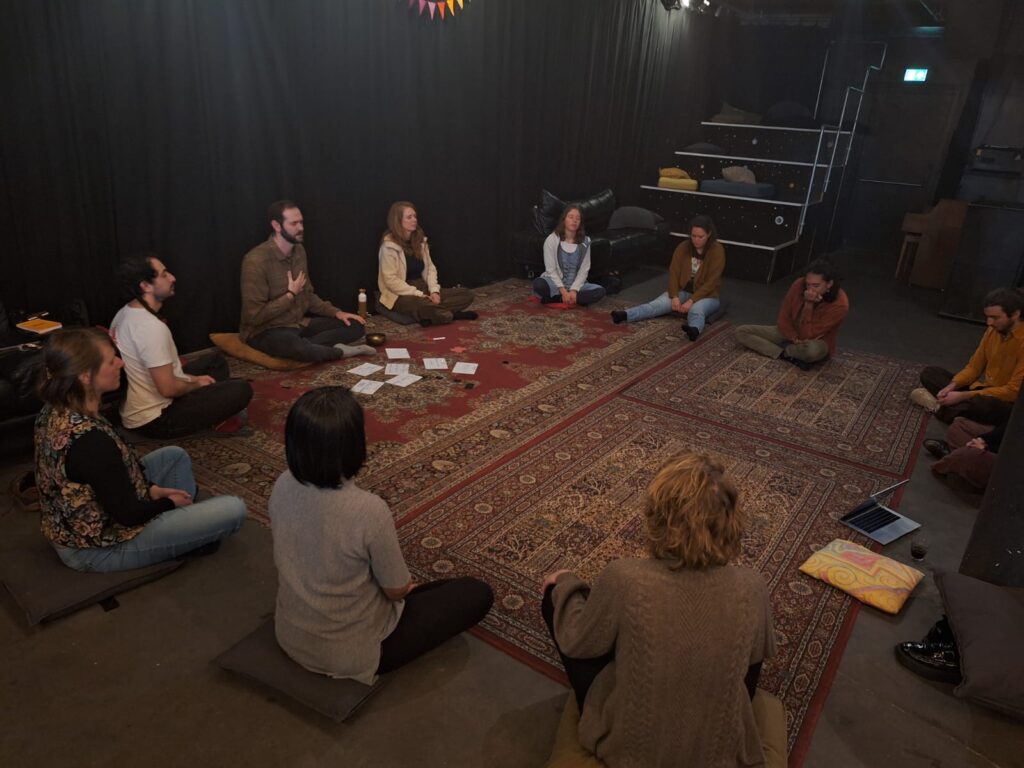
Many research initiatives today aim to improve equity and inclusion, yet in practice the perspectives that shape research priorities often come from institutional stakeholders alone. These expert perspectives help define what inclusion should look like and which questions matter most — while the lived experience of the communities these projects aim to serve remains only partially present in the research process itself. Time pressures, funding structures, and institutional infrastructures all shape whose voices become visible in the production of scientific knowledge, even in initiatives explicitly aimed at improving access and equity. Outside academic institutions, however, other kinds of spaces exist that center lived experience. Storytelling venues such as Mezrab offer open platforms where people share personal narratives: migration journeys, identity struggles, memories, and everyday experiences. During the mapping exercise, Mezrab itself became part of the system we explored — as a stakeholder and a possible bridge between lived experience and research practice.
The session was beautifully facilitated by Frederique Demeijer and Jaro Pichel, who introduced participants to the origins of Social Presencing Theater and the 4D Mapping practice developed by Arawana Hayashi. Before moving into the mapping, we began with a short embodiment exercise that helped everyone slow down, tune in, and become present to the shared space.
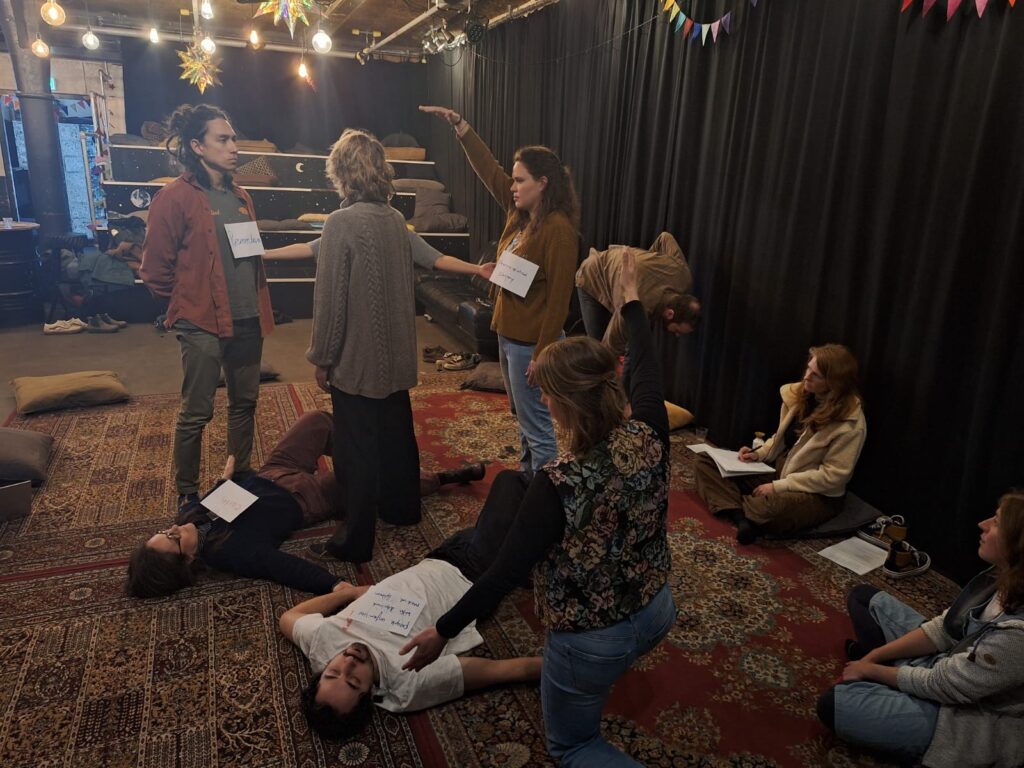
Participants came from a wide range of backgrounds, creating a rich and open atmosphere for exploration. In the mapping, participants embodied a range of stakeholders within the system: the body of knowledge in its traditional sense, researchers, pharmaceutical companies, people unfamiliar with the dominant medical system, alternative spaces such as Mezrab, the earth, and the highest potential of knowledge. Each role entered the space with a clear, almost assertive positioning, expressing its own perspective and orientation within the system. As more roles stepped in, the dynamic began to shift. Participants could feel, and later also articulated, how the energy in the space was changing as relationships between the different actors became more visible. This gradual build-up led to the formation of the first sculpture, representing the current state of the system. In the second sculpture, something noticeably shifted: participants began to orient more towards one another, and the overall configuration became more interconnected. The system felt less fragmented and more relational, with a stronger sense of mutual awareness and potential alignment emerging between the roles.
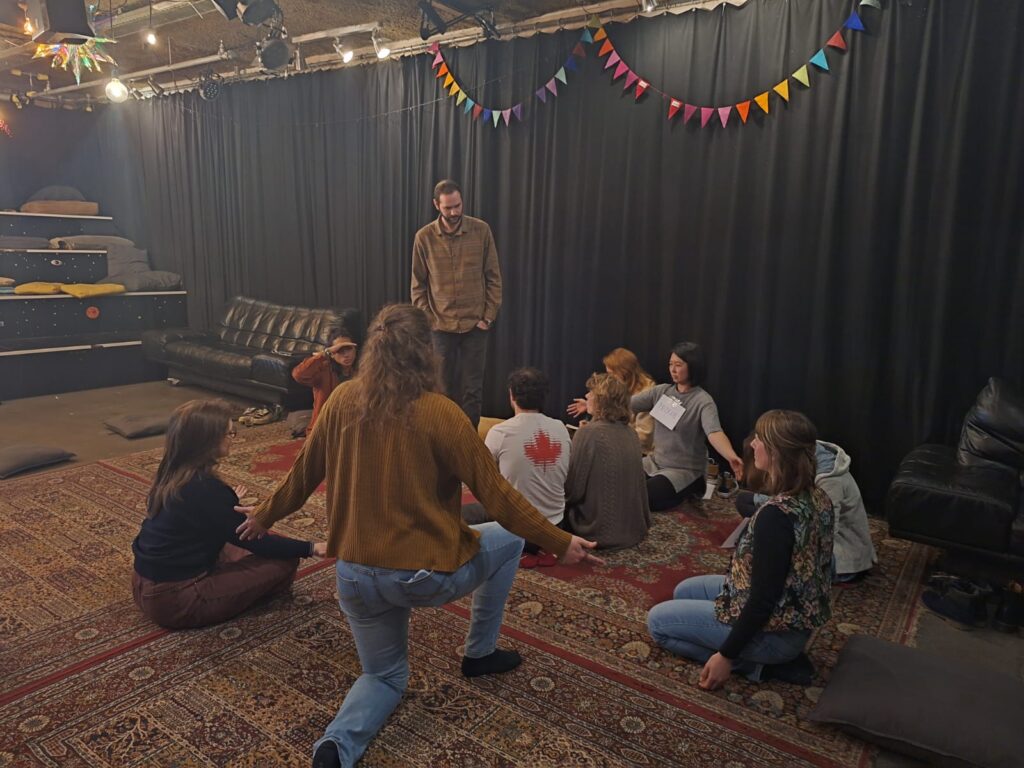
After the mapping, we stayed together to reflect and continue the conversation over coffee, homemade food, and Mezrab’s heart-warming soup, making the afternoon feel all the more warm and communal. The insights from this reflection can have spillover effects on how we approach collaboration, especially over wicked problems that integrate more than one or two perspectives and include vulnerable populations: with more understanding, empathy and new collaboration approaches. Such sessions can be repeated as a way of further delving into research questions and project goals, when a new project or collaboration is initiated.
Exploring complex questions around inclusion and equity quickly reveals that it is, at its core, a relational endeavor: something that benefits from being explored together, across disciplines, experiences, mediums, and ways of knowing. It was a day of insightful reflection, new connections, and shared curiosity – and we hope it is only the beginning of many more conversations to come.
