By YiLing Hung, researcher in residence
On the 24th of April, CUCo’s researchers-in-residence held a work session in Utrecht. We gathered at a building of HKU University of the Arts located on the edge of the city center. It was a cozy small work group with three participants.
The starting point
The activity was developed from my interest in the role of visual elements in a research context and the differences/similarities between presenting research findings through text and visuals. I used two anthropological and philosophical texts focusing on “reading” to prepare this session: Drawing, Making, Writing by Tim Ingold[1] and Essay on the Notion of Reading[2] by Simone Weil. Ingold argues in this article that, if putting thoughts on paper is a process of giving a form to thoughts, then visuals/images should be seen as a material medium the same as text; on the other hand, Weil, from a more embodied perspective, sees “reading” as relating to “experience” – you perceive something, you feel something inside, and you look at the world differently. For her, reading then is a way that we use to construct our worldview, no matter whether we are reading a piece of text or reading activities on the street.
The work session
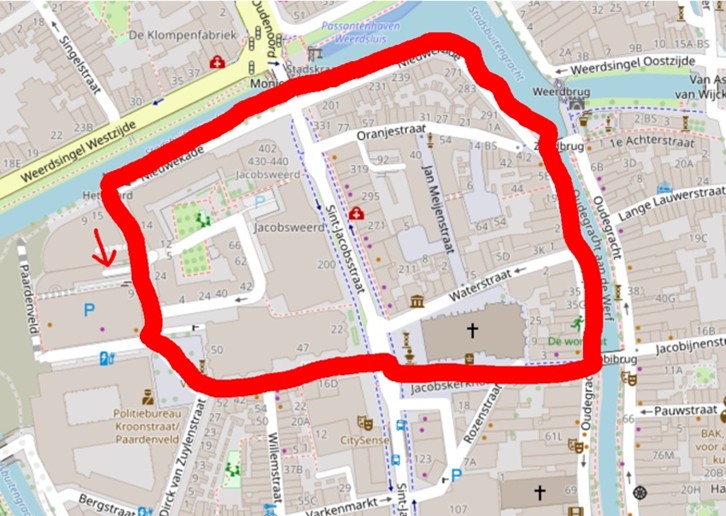
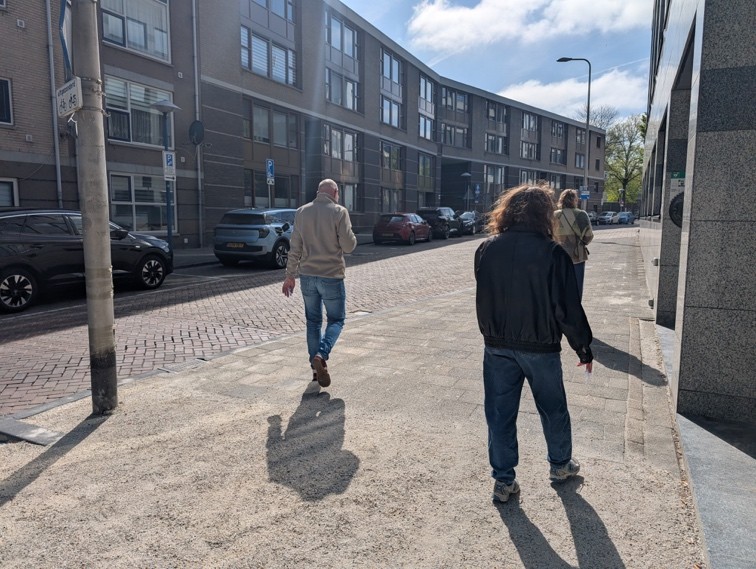
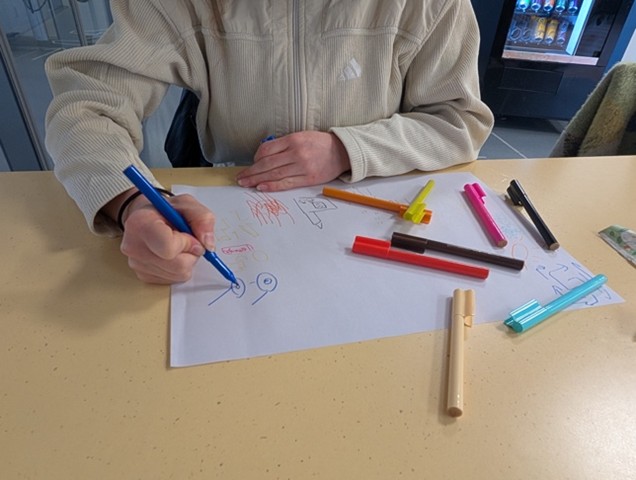
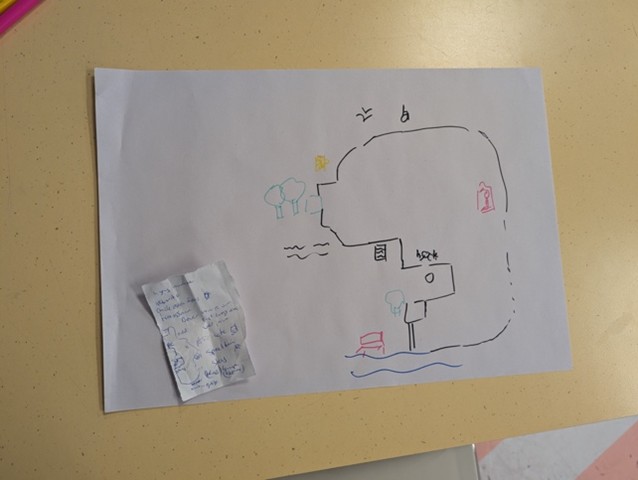
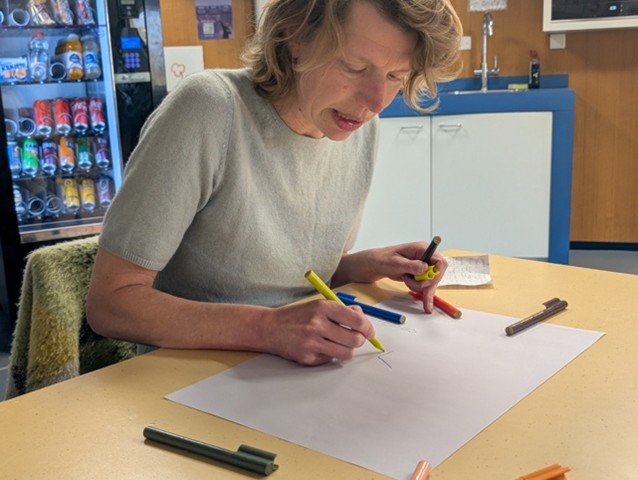
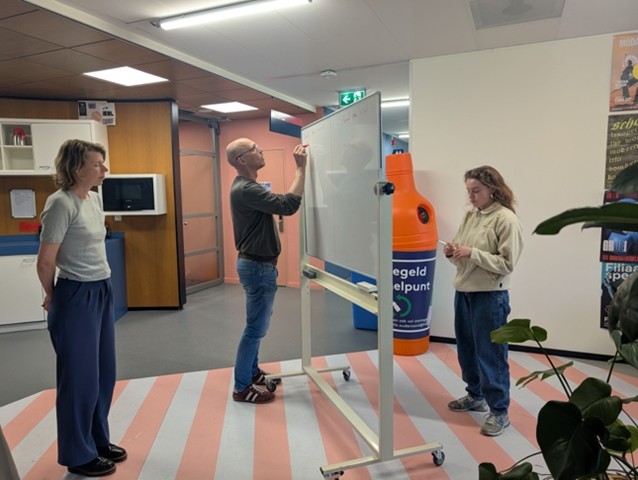
We started with a short introduction to Tim Ingold and Simone Weil, whose articles provided the starting point for the activity. Then we took two rounds of walking around the HKU building – the first time as a whole group, and the second time, the participants walked individually. A small assignment was given to them prior to the walk: collect elements in the surroundings that are related to your (research) work. After the walk, we went back inside to present the individual findings by drawing (a map) – participants were drawing at the same time as sharing (orally) their walk. To close the work session, all of us wrote down our reflections on three questions: what did you experience while “reading” the city; what did you find in visualizing the experience; and what thoughts came up from reading others’ visualizations?
What did we discover?
We all agreed that this practice of walking in the city offers us a possibility to find inspiration when we allow ourselves to slow down, to be open, and to be curious. We might look at the surroundings with bias, or, to put it another way, through our own lens, but we might also find surprises in the surroundings without knowing why at first. When it comes to visualizing the walking experience, more critical reflections were mentioned: there was an association with power dynamics (e.g., being selective in what to mention (or not), finding it difficult to interrupt as a listener, and the order of sharing/drawing impacting the results); in the process of drawing, creating a coherent story became important, even if the real experience didn’t necessarily contain such coherence – “meanings” might be made at the moment of drawing; and a realization of the fact that visuals have been undervalued in presenting (research). Being a reader/listener of others’ drawing-presentations, we found that the content of the others and the way they combined drawing and oral sharing were inspiring and enjoyable. Reading others’ visualizations could help with connecting, reflecting, and relating one’s own experience to others.
What could be next?
Originally, my goal for this work session was to get some inspiration for my PhD project – which I am in the final phase of writing, and where visual elements take up an important space in the research. However, after the session, I discovered more potential in combining walking and drawing – perhaps it can continue to be developed into a kind of toolkit, such as for guiding students/researchers to discover their research interests or for offering an alternative way of sharing and discussing research findings, or simply for people to reconnect to the environment and to find new things within it.
Special thanks
The Centre for Unusual Collaborations and HKU University of the Utrecht for offering the resource and space; and the participants Anke de Vrieze, Liza Veldt, and Peter Oosterhoff (listed in alphabetical order), your participation made the discussion rich, valuable and fun.
YiLing Hung. PhD candidate at WUR; Artistic Researcher and Teacher at HKU; Researcher in R-i-R 2025-2026 at CUCo / yiling.hung@wur.nl / https://yilinghung.com / https://www.linkedin.com/in/ylredhung/
[1] Ingold, T. (2011). “Drawing, Making Writing”, Being Alive – Essays on Movement, Knowledge and Description, p.177 – p.179. Routledge.
[2] Weil, S. (2020). Translated by Chris Fleming. “Essay on the Notion of Reading”, The Journal of Continental Philosophy, p.9 – p.15. doi: 10.5840/jcp20205202.
