In late June 2026, the CUCo team attended a summit on interdisciplinarity hosted by Western University’s Rotman Institute of Philosophy. This post is a recap of our experiences leading up to and during the summit. Many thanks to the team at the Rotman Institute (Dan Lizotte, Paul Arnold and Kate Sinclair) for organizing the summit and hosting us on the university campus.
By Tom Bouwmeester
hospitality
The act or practice of being hospitable; the reception and entertainment of guests, visitors, or strangers, with liberality and goodwill.[i]
At the end of 2025, we had already checked out for the Christmas holidays (theoretically, at least) when the letter arrived in CUCo’s mailbox: an invitation from across the Atlantic to attend a three-day summit on interdisciplinarity at Western University’s Rotman Institute of Philosophy in London, Ontario. The summit’s key themes were to be hospitality and knowledge integration. We were immediately excited about the potential this invitation held for CUCo, but also a bit cautious: having run CUCo with a skeleton crew for the better part of 2025, and our new manager Megan yet to start, we were still very much in a transition. That said, we were eager to enter into a conversation with the people at the Rotman Institute.
butterfly effect
In chaos theory: the phenomenon whereby a small change in some complex systems can have a large effect at a later time; (also) a specific instance of this phenomenon.[ii]
And so, in January 2026, we scheduled a Zoom meeting with Dan Lizotte and Paul Arnold from Western University on one end and Anke de Vrieze and me, Tom Bouwmeester, on the other. One of the more burning questions on our end was: how did you find us, and what made you invite CUCo? It turned out that Paul had come across CUCo’s article, Finding joy, creativity and meaning through unusual interdisciplinary collaborations, while doing research for the summit. We were pleased to see that the article had its very own butterfly effect, resonating across the world to enable new connections and collaborations. We promised to keep in touch and discuss internally whether it would be feasible for the CUCo team to attend the summit. Our excitement grew in the weeks that followed. It took us another month or two to work out the details and then, finally, confirm our participation.
interdisciplinarity
In interdisciplinary thinking and working, you take an extra step: you try to integrate perspectives or insights from different perspectives through interaction, in order to better understand a complex phenomenon.[iii]
The summit featured a number of international partners working in the field of interdisciplinarity, such as the Bielefeld-based Center for Interdisciplinary Research (ZiF) and the Centre for Humanities Engaging Science and Society (CHESS), along with researchers from Western University working in the field of interdisciplinarity. The summit featured a high quality of contributions throughout, and discussions were improved by the fact that we were a relatively small group of about 40 participants, which allowed for a more productive exchange compared to a larger conference.
We were particularly inspired by a presentation from our colleagues from the Université Laval in Quebec City, Keith Lévesque and Marie-France Gévry, on coordinating interdisciplinary initiatives, a workshop on productive interdisciplinary collaboration from the colleagues at ZiF, Anika Haverig and Nadine Sutmöller, as well as Katie Plaisance and Bethany Laursen’s work on knowledge integration. Many new connections formed, and we look forward to working with the other institutes bilaterally and collectively in the years ahead. We hope to shortly announce some of the initiatives that were discussed during the final wrap-up session.
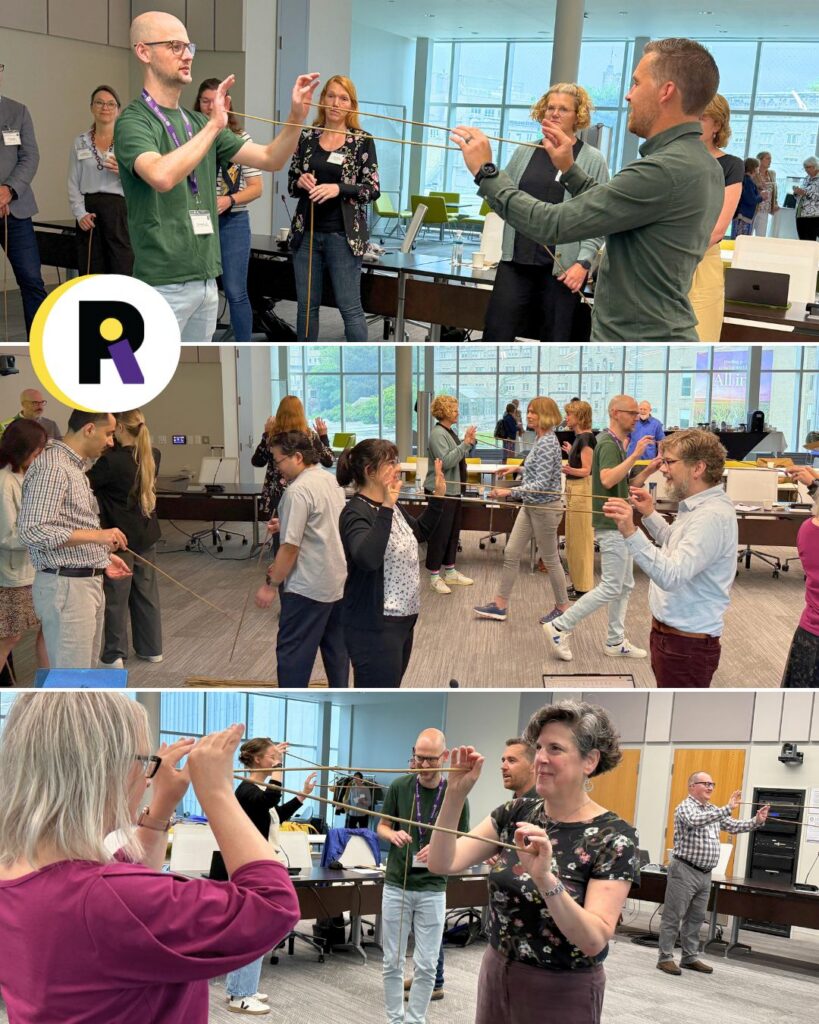
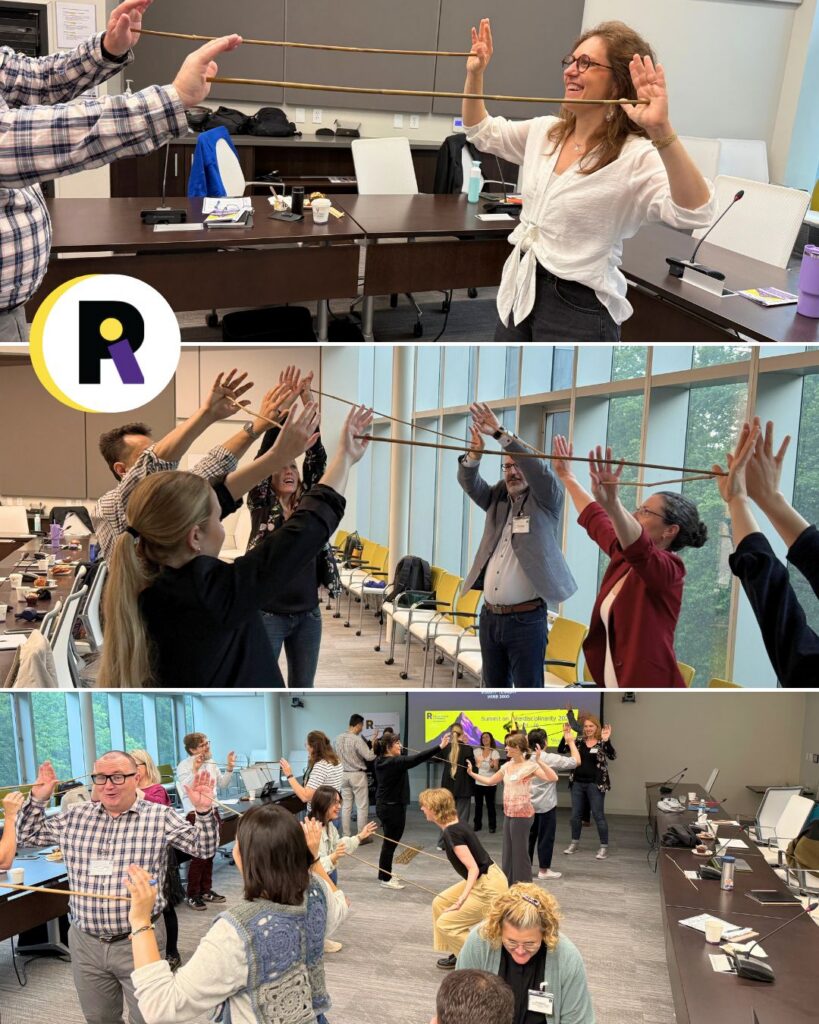
stick exercise
Exercise from the CUCo toolkit aimed at surfacing reflections on collaboration and finding common ground through an experiential activity using sticks and movement.[iv]
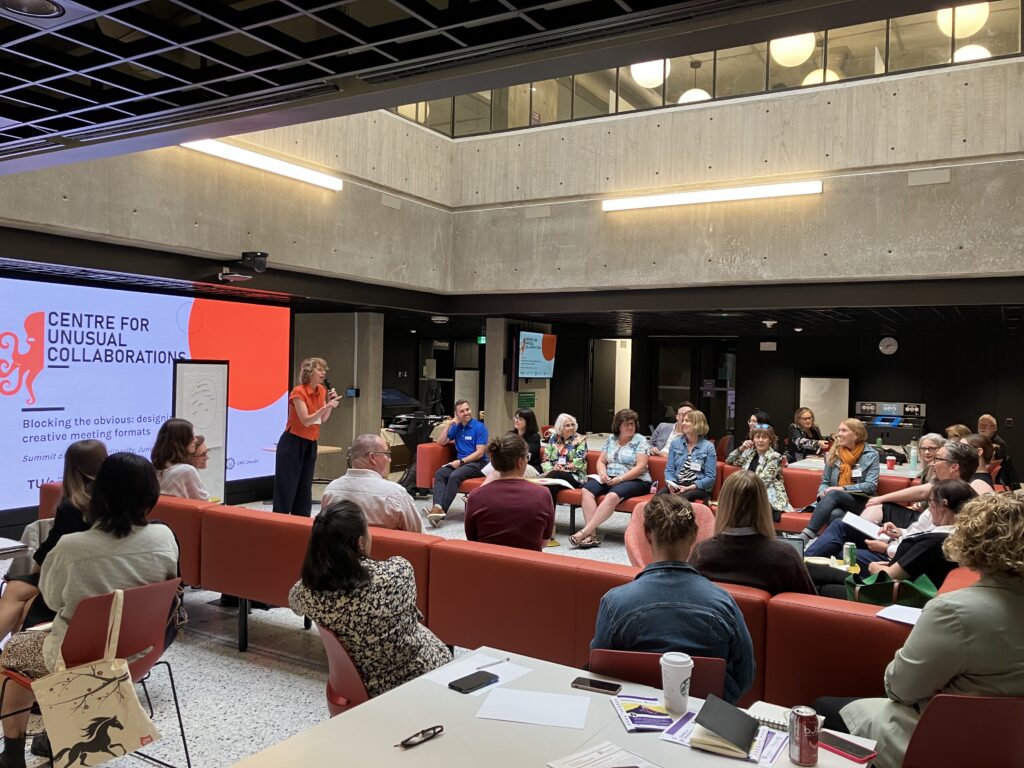
CUCo itself ended up facilitating two interactive sessions at the summit: a workshop on blocking the obvious, to help participants design new creative meeting formats, which Anke had already trialed at the Dutch national expertise center NECTR day in Amersfoort in November 2025, and the stick exercise, developed by Anke herself and used extensively in CUCo’s Spark training in the past years. These methods respectively spoke to the outside-the-box approach and the focus on embodied learning that CUCo is known for. We were pleased to find that both sessions were well received in an international context, sparking thoughts on new ways to collaborate and collateral happiness as well. (And also, the Sync Claps proved to be a successful energizer once again, particularly for a 9 AM start!)
transdisciplinarity
Research that integrates knowledge across academic disciplines and with non-academic stakeholders to address societal challenges. It is guided by the principle that ‘scientific rigor meets societal relevance’.[v]
Transdisciplinarity is CUCo’s new frontier, and something we’re yet to properly explore after having mainly focused on fostering interdisciplinary collaborations for the past five years. Several CUCo-funded projects did already have transdisciplinary elements, such as All in the Same Boat’s collaboration with the Dutch Water Museum, Frozen in Time and Space’s collaboration with an artist, and Clean Future: Wellbeing in Dirty Work’s case studies (and artistic collaboration as well, for that matter).
With a panel session dedicated to cross-sector knowledge mobilization in public health and public policy in Canada, the summit also brought us inspiration in terms of transdisciplinarity. We were reminded once more that it’s important to create truly equal collaborations with societal partners and steer away from knowledge extraction, where academia simply takes what it needs and the working relationship is exploitative rather than reciprocal. These are challenges we wish to address in CUCo’s new Fellowship Programme, due to launch in September, and throughout the years ahead.
The summit provided us with a renewed sense of determination to keep doing what CUCo was set up for: to equip people with the virtues, skills and sensibilities to take part in unusual collaborations, enabling them to deal with the pressing challenges of this day and age.
[i] Definition taken from Oxford English Dictionary, https://www.oed.com
[ii] Definition taken from Oxford English Dictionary, https://www.oed.com
[iii] Cited from Multi-, inter-, and transdisciplinarity; what is what? – Educational Development & Training – Utrecht University
[iv] Stick exercise – Centre for Unusual Collaborations
[v] Cited from What is transdisciplinary research? – Transdisciplinary Field Guide – Utrecht University
