Written by Meyke Roosink
Meyke Roosink is a researcher-in-residence at CUCo, together with fellow residents Nikoletta Georgiou and YiLing Hung. Meyke’s focus is on exploring the use of a so-called “DUO bicycle” as a vehicle (literally!) for exploring needs and use cases for activity-based collaboration. In this interim report, Meyke integrates and documents the findings and experiences of her residency thus far. A summary of the interim report is provided below. The complete interim report can be downloaded below.
Meyke’s residency started from three basic notions: 1) Transdisciplinary collaboration is essential for addressing societal challenges like health and healthcare innovation, 2) Outdoor physical activity is essential for maintaining vitality and creativity of researchers and innovators and for staying connected to our surroundings, and 3) For innovation and transdisciplinary collaboration we need activities or interventions that take us “outside the box” and “out of our bubble”. These notions were explored specifically for activity-based collaboration on a DUO bicycle using desk research, during several events, and during a dedicated researcher-in-residence work visit.
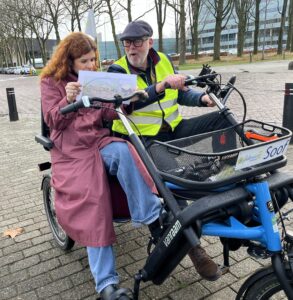
All piloted DUO bicycle interventions were experienced very positively, and participants could imagine themselves using the DUO bicycle for professional (e.g. with colleagues or stakeholders) and personal use (e.g. with family) and in the context of volunteer work. Potential benefits of activity-based collaboration on a DUO bicycle that were reported during the work-visit included for example: health, being outdoors, relationship building, being offline, fun, other type of conversations, and feeling of accomplishment. Potential barriers that were identified included: bad weather, longer time investment, resistance, lack of trust, difficulty to capture notes, physical disability, and traffic disruptions. Importantly, the DUO bicycle allowed for perceiving a certain closeness to others which is considered essential for successful transdisciplinary collaboration. Interestingly, the closeness to others was overall rated higher for side-by-side cycling as compared to walking.
Several explanations for the positive effects of cycling together relate to the fulfilment of basic psychological needs, to psychological flow (allowing for collective enjoyment, shared goals, task interdependence, and mutual trust), and to interpersonal cooperation through specific neural mechanisms. Indeed, it would be very interesting to further research the effects and mechanisms of activity-based collaboration on a DUO bicycle in professional work environments. This could relate to aspects of collaboration (including tensions and power dynamics), but also to aspects of health and vitality, and other types of societal impact (e.g. advocating for volunteer work, active travel, and inclusion/equity).
Next steps will be to use these results to evaluate CUCo’s offering in terms of activity-based collaboration, to develop a workshop on Equity in Knowledge Creation based on the integrated results from all three residents, and to inform a potential business model.
Read or download the full report below:
